Play-Cricket records the cricket. Wicket takes on the job around it, which is the committee’s: opposition contacts, availability, selection, match fees, subs, the cash book, meetings and minutes, the standing jobs that come round every year and, if you want one, a public club website. A login for every post, and each post sees its own part.
Nothing to pay until 31 December 2026 · Cancel any time
The connection is read only. Fixtures come into Wicket with your club’s own site ID and key, and nothing is sent back out.
The squad imports from a spreadsheet, the fixtures pull from Play-Cricket, and the cash book can start from a bank statement.
Availability goes out as a private link, one per player. There is no player app, no account to create and no password to remember.
A committee split the work up, so the records split with it. Wicket does not take anybody’s section off them. It puts every section in the same account.
The fixtures secretary holds the fixtures. The treasurer holds who has paid. Whoever picks the side holds availability. The membership secretary holds the contact details. Five records, because there are five officers, and each keeps it their own way.
Each post keeps its own part and gets its own login. Nothing is taken off anybody. What changes is that all five parts sit in one account and agree with each other.
A post changes hands at the annual general meeting and the file goes with the person who kept it. Their successor starts a new one. Nobody calls it a crisis, because only one section went.
The records sit in the club’s account, not in five personal files. A post changing hands means somebody is added on the committee logins screen, not somebody starting from scratch.
Nobody hands the whole spreadsheet over, because the whole spreadsheet holds things that are not everybody’s business. So the sections stay apart, and nobody ever sees all of it.
Permission is set per post. The treasurer sees Finance and not the squad notes. The captain sees selection and not the cash book. All in one place does not mean all on show.
Five steps. Four of them are imports or a single screen, and the fifth is sending each player a link. No IT knowledge, no training and no migration project to sit through.
Upload the spreadsheet the club already keeps. Nobody types forty players in again.
Put your club’s own Play-Cricket site ID and API key into Settings and bring the whole season in at once, or type the fixtures into the season grid. The link is read only.
Import a bank statement and the treasurer’s year starts from what the bank says rather than from a blank page.
Add the treasurer, the fixtures secretary, the captains and the membership secretary from one screen. Each sees their own part and nothing else.
Each player gets their own link. They open it on any phone and tap available or not available. That is the whole of what the squad has to do.
Play-Cricket holds the league programme. The group chat holds the chatter. These four have no home, which is exactly why they end up in one person’s own file.
Play-Cricket records a friendly perfectly well once it is arranged. The awkward bit is arranging it, when the opposition contacts that make it easy live in one person’s phone. Wicket takes every fixture you play and keeps the contact book against the club. Enter the opposition’s contact once and it shows on every future game against that side, carried between seasons and between whoever holds the job.
Agenda, minutes and what was agreed, plus action points that each carry an owner and a done tick. Committee only, and never on a player’s link. No hunting back through last year’s minutes to work out what was decided.
The fee follows selection. Pick a player and the charge appears; leave them out and there is nothing to pay. The junior rate is applied on its own, and never above the adult fee. Cash, bank transfer and card all land in one running balance per player.
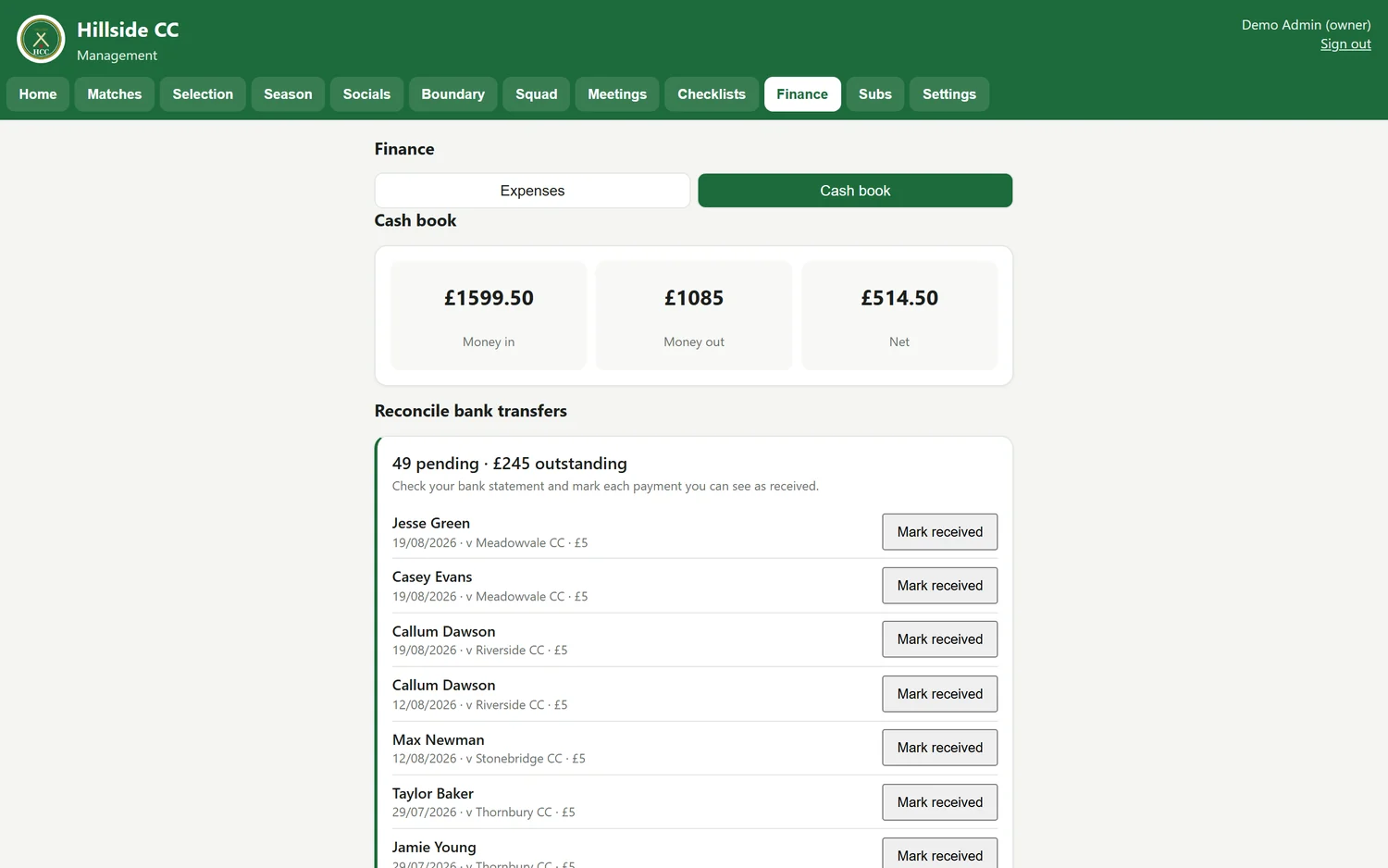
Money in, money out and the net position, filtered to any season. Expenses with the receipt attached from a phone. Import a bank statement to reconcile, and download the lot as CSV whenever the treasurer asks.
A committee post signs in and sees the areas that post is entitled to. This is all of it, not a shortlist, because the part that decides it for the treasurer is not the part that decides it for the fixtures secretary.
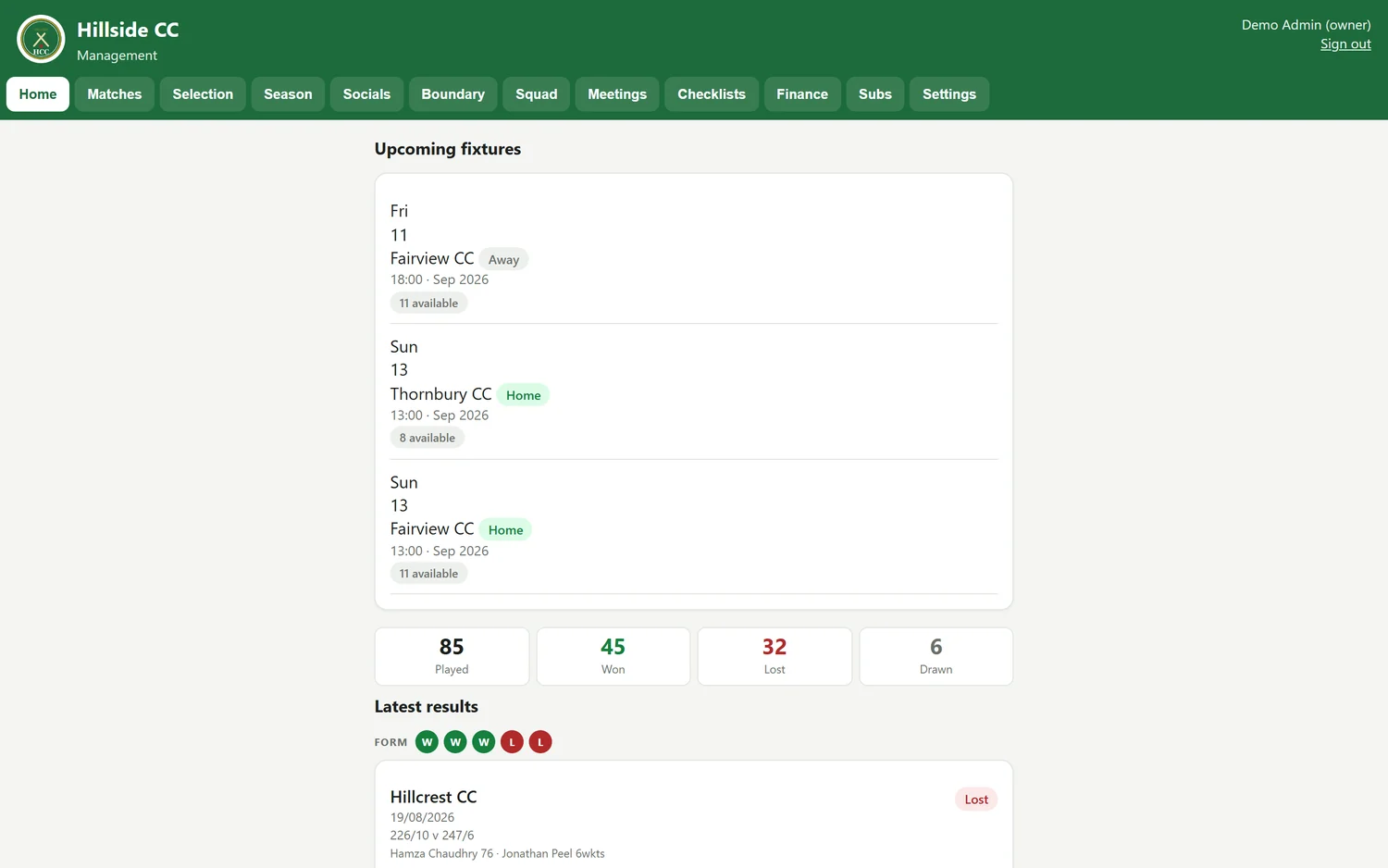
The club’s position at a glance on opening: what is coming up, what is outstanding and what needs a decision.
Every fixture the club plays, league, friendly, midweek, cup and pre-season alike. Import a season from Play-Cricket with the club’s own site ID and API key, or enter them in a season grid. Results and match reports are recorded against each game. The Play-Cricket link is read only: fixtures come in and nothing goes back out.
Each player gets their own private link. They tap available or not available from any phone, with no app to download, no account and no password. The club watches the responses come in across every side at once rather than one team at a time.
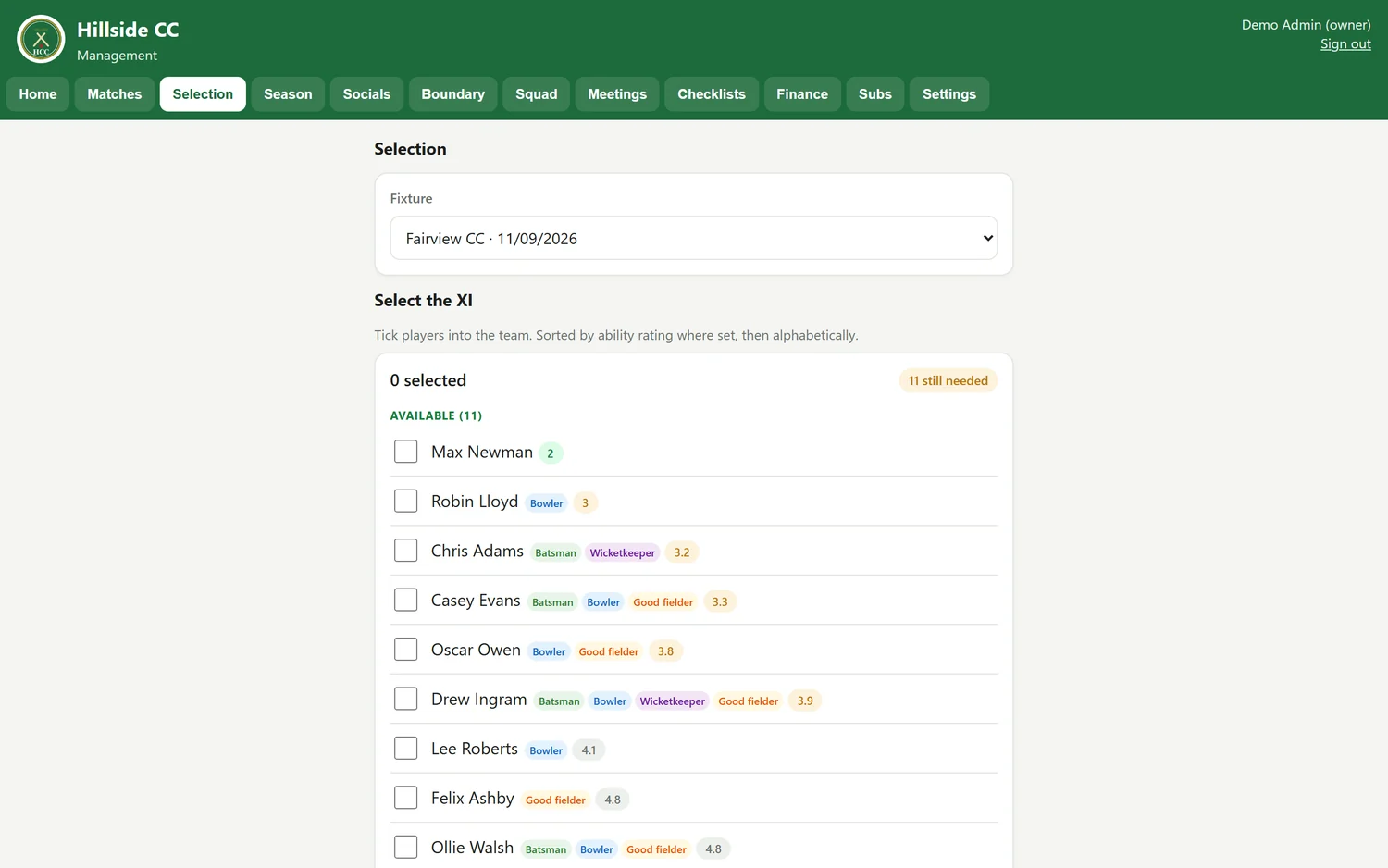
Pick the side straight from the confirmed-available list. Selectors keep private ability ratings and batting or bowling styles, and those are never visible to the squad.
One register for every member: contact numbers, junior flags, emergency contacts, safeguarding consent, league registration and player categories the club defines itself. Import the squad from a spreadsheet. Know who is eligible before you name the side.
The fee follows selection. The junior rate is applied automatically and never exceeds the adult fee. Cash, bank transfer and card all land in one running balance per player across the whole season, so nobody has to reconcile three lists at the end of it.
Money in, money out and the net position, filtered to any season. Expenses entered with the receipt photographed from a phone. Import a bank statement to reconcile. Donations and sponsorship income are recorded here too, and the whole book downloads as CSV whenever the treasurer asks.
Subscription rates by category, who has paid, who has not, and what is outstanding, held alongside the match fees rather than in a separate book.
Voluntary donations recorded with the declaration held against them, and an HMRC claim file to export, for clubs that hold CASC status. Gift Aid is claimable on donations and not on match fees or subs, and the screen says so.
Agenda, minutes and what was agreed, plus action points that each carry a named owner and a done tick. Committee only, and never visible on a player’s link.
Pre-season jobs, ground work, affiliation tasks. Each item is owned by a committee post rather than by a person, so when the post changes hands the job goes with it instead of being lost. Resources can be attached to an item.
A written reference library for raising money and finding members, in six parts, with real clubs named and real figures attached. It is set out in full further down this page.
The club’s social calendar: a tour, curry nights, race nights and presentation evenings, with sign-up sheets, deposits, balances and a shared itinerary. This one is being built and is not part of the account today.
Set once, and they hold in every area above.
Permission is set per post. The treasurer sees the money and not the squad notes. The captain sees selection and not the cash book. Any number of sides on one shared squad, and every login is included in the price.
Availability asks, team announcements and fee reminders come written for you. One tap opens your own WhatsApp with the text filled in, one player at a time. Wicket does not send anything itself and never messages anybody on the club’s behalf.
Available on admin accounts, because a club account holds members’ contact details, junior records and the club’s money.
Who changed what, kept behind the committee logins, so a question about a figure has an answer rather than an argument.
One button downloads every record the club holds here as a folder of spreadsheets. It stays available even if you stop paying, because a club’s records are the club’s.
Money a club collects goes straight to the club. Wicket takes no percentage of anything the club collects.
A written reference library inside the account, in six parts. Each entry names real clubs and carries real figures, and it says plainly where a route is well founded but the return has never been measured. That honesty is the point of it.
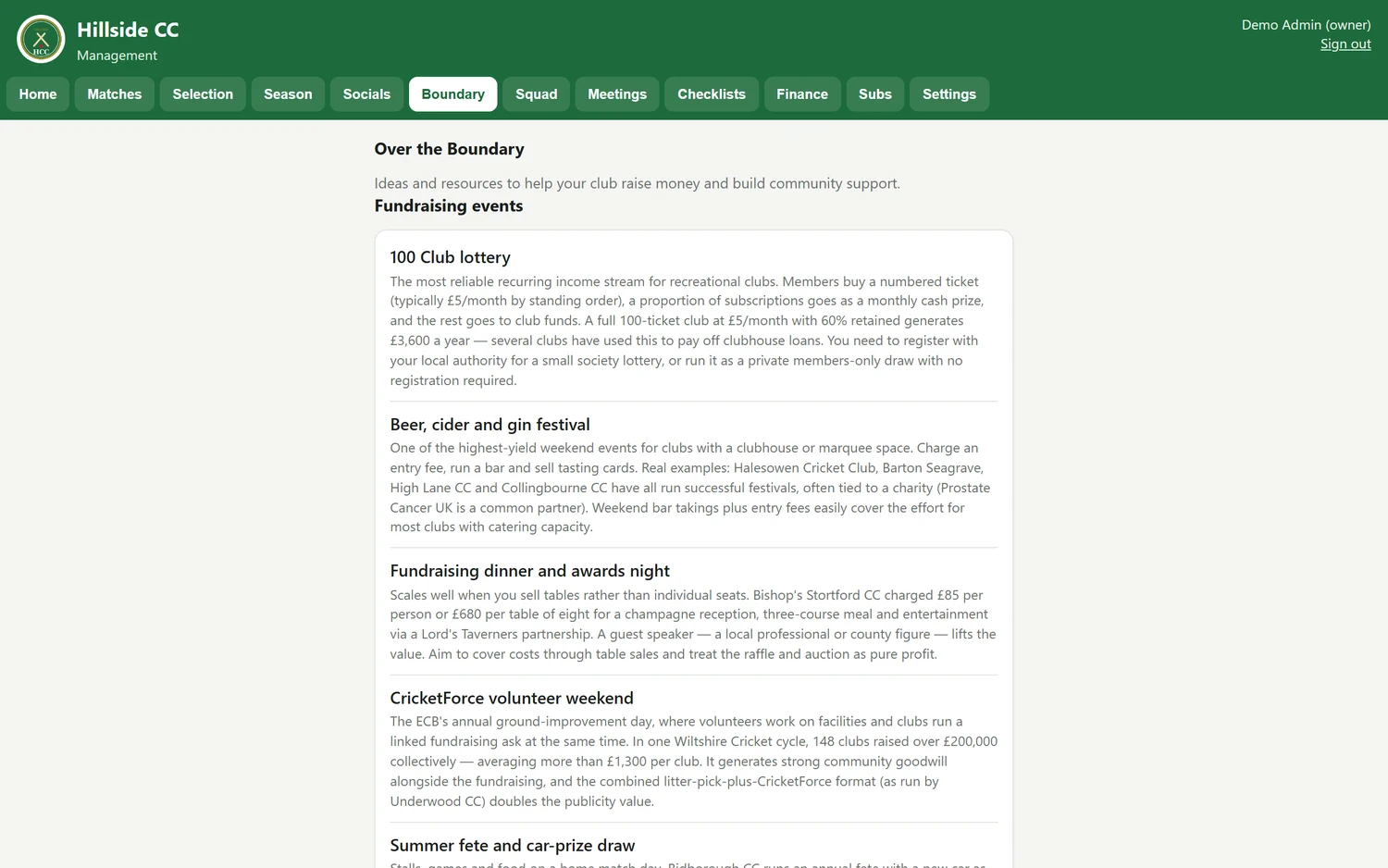
A 100 Club lottery written out in full: how it runs, the usual £5 a month by standing order, what a full hundred tickets returns in a year at 60 per cent retained, and the licensing position for a small society lottery. Beer, cider and gin festivals with clubs named. A fundraising dinner and awards night with a real club’s per head and per table prices. The ECB CricketForce volunteer weekend, with what one county’s clubs raised across a cycle. Summer fetes and car-prize draws, quiz nights, race nights, sponsored cricket-a-thons, crowdfunding, and easyfundraising as passive income.
Chance to Shine school cricket, junior open days, charity matches, ground open days, litter picks and the community noticeboard. Each one written up as a route to support and new members rather than as an event that stands on its own.
The ECB County Grants Fund, the Sport England Community Asset Fund, the National Lottery Community Fund, local authority grants and Cash4Clubs, with what each is for. CASC registration with HMRC is covered too, because it is what makes several of the others worth claiming.
Pitchside advertising boards, shirt sponsorship, match ball and player sponsorship, season headline sponsorship, and in-kind contributions from local firms that would rather give materials or labour than a cheque.
Social membership and life membership, with three real clubs’ fee structures written out, including one that gives social members a vote at the annual general meeting. Gift Aid on donations, ground hire, monthly subs by instalment, and all-in membership with match fees included.
The parents already standing on the boundary at All Stars and Dynamos sessions, with the survey finding on how many said they would help if somebody asked. Women’s and girls’ soft ball festivals, the documented staged route in, and an entry requirement as low as eight players. Keeping the 16 to 19 year olds you already have, following the ECB’s Stay in the Game work, with three fixes that cost nothing. Walking cricket and midweek eight-a-side as routes back for lapsed players. And the finding that runs through all of it: clubs assume rather than ask, and the ask has to name a role and a time commitment.
£7.50 a month or £75 a year on top of the plan, or leave it. It publishes from the records the club is already keeping in the account, so keeping it current does not become a second job for somebody.
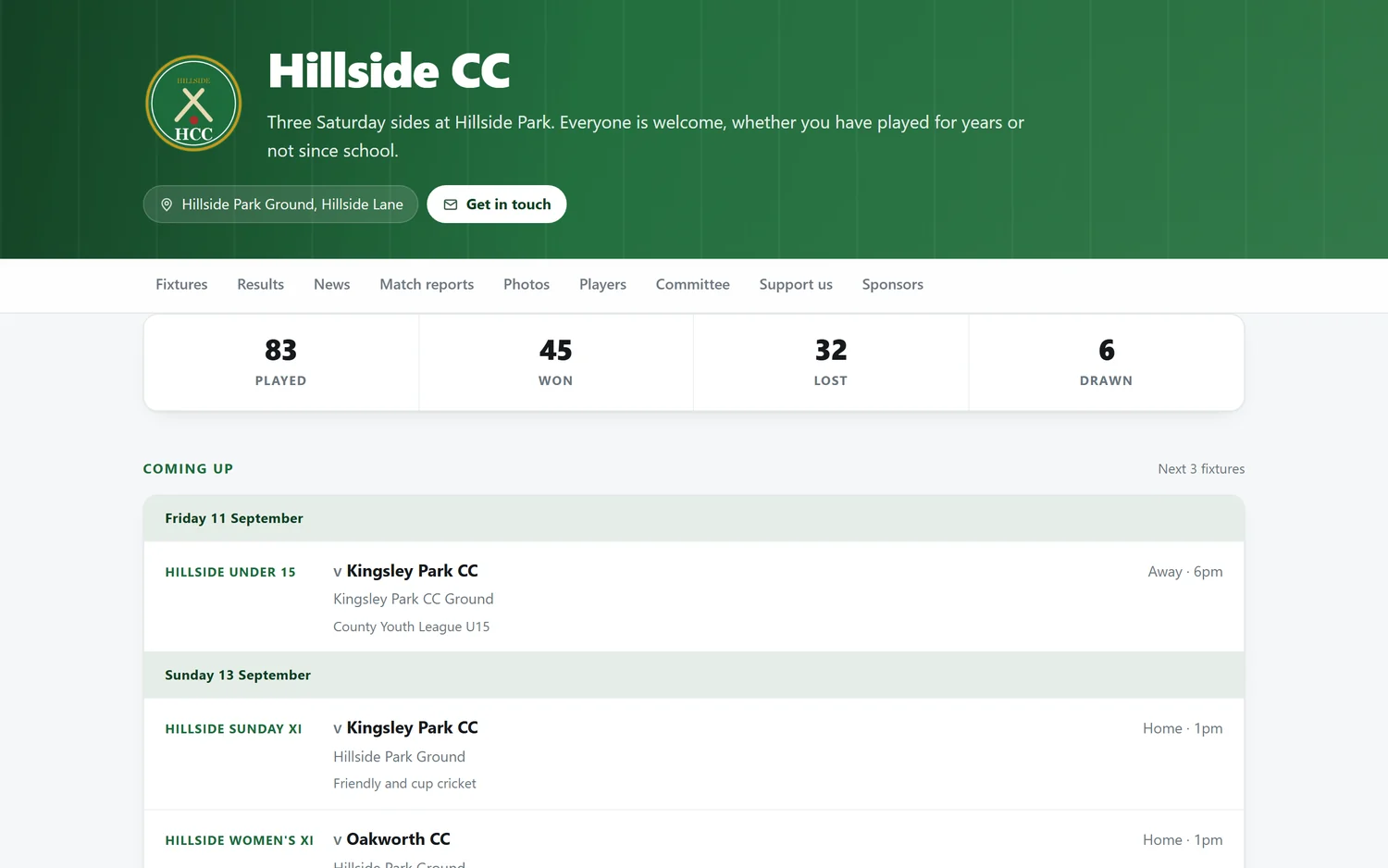
Fixtures coming up, recent results, what has been played this season and the match reports written against each game. All of it comes from the fixtures the club already entered or imported.
The club’s own description, news and notices, the committee and officers, photographs, a welcome section for new players and a section on supporting the club, with easyfundraising alongside it.
Sponsor logos shown in the tiers the club decides, so a shirt sponsor and a board sponsor are not given the same billing.
Nothing is sold on a club’s page. Everything capable of identifying a person is switched off until the club switches it on, and under 18s are never named on it.
One price for the whole club, whatever the size of the squad and however many sides you run. Every committee login is included.
Nothing to pay until 31 December 2026. You enter your card when you sign up, Stripe charges nothing until then, and you can cancel any time before it. Setting your club up is self-service and included: you import your own squad and pull your own fixtures from Play-Cricket. Paying yearly saves you two months.
Every screen, including the cash book, the committee minutes and Over the Boundary, with no account and no card.
Open the demo